Case Study 1
Item set
Items
-
 Women's Labour History Project: Summer 1979 Guide to Collection: Provincial Archives of British Columbia; SFU; BC Federation of Labour Oral history summaries / guide to collection. Missing pages 21-24.
 -
 Women's Labour History Project Guide to the Collection (1978-1979) Prepared by Sara Diamond Women's Labour History Project Guide to Collection (1978-1979) prepared by Sara Diamond including women's labour history project interviewees and descriptions.
 -
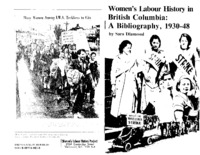 Women's Labour History in British Columbia: A Bibliography, 1930-48 Bibliography of Women's Labour History in British Columbia, 1930-1948 compiled by Sara Diamond. Includes general sources, the depression years, the war years, and the immediate post-war period.
 -
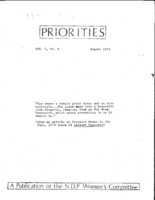 Women's Committee Policy Paper An article by the BC NDP Standing Committee on Women's Rights in Priorities Vol 1 Numer 08, August 1973. The article explores women's rights and fight in the party (NDP), as it lists the party's goals and claims the sexism that exists towards women outside and within the party.
 -
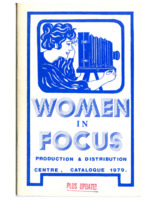 Women In Focus Production & Distribution Centre, Catalogue 1979 [Red stamp: “Plus Update”]. A catalogue of Women In Focus Society produced videos and film to 1977. A 1980 update with international additions by outside producers, slide/sound presentations, leaflets.
 -
 Women In Focus Production & Distribution Centre, Catalogue 1979 [Red stamp: “Plus Update”] A catalogue of Women In Focus Society produced videos and film to 1977. A 1980 update with international additions by outside producers, slide/sound presentations, leaflets.
 -
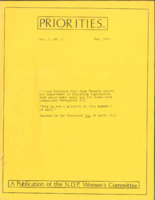 Women at Work An article by unknown writer in Priorities, Vol 1 Number 03, March 1973. A general view on labour action happening in BC at that time: Wardair Stewardesses' strike, Shopper's Drug Mart worker’s fight for unionize, and Denny's Restaurant boycott.
 -
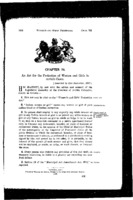 Women and Girls' Protection Act, Chapter 76 Women and Girls' Protection Act, Chapter 76, 1923
 -
 Woman Alive Series: Interview with SORWUC representatives, 1977. An interview with SORWUC representatives Pat Barter and Charlotte Johnston about the history and mandate of the Service, Retail and Office Worker Union of Canada. Broadcast on the Vancouver Status of Women "Woman Alive" series, Vancouver Cable 10 in 1977. Host: Gayla Reid Guests: Pat Barter; Charlotte Johnston Executive Producer: Laine Lunde Director: Catharine Ackroyd Crew: Laine Lunde, Dana Singer A Vancouver Cable 10 Production
 -
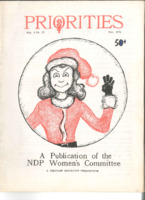 Wages Against the Housework; United Banks Workers A review by Ardith Roscoe and an interview by Sandra Boucher with Jackie Ainsworth and Dodie Zerr in Priorities Vol 4 Numer 12, December 1976. While the review discusses wages for houseworkers, the interview is about organizing banks in downtown Vancouver.
 -
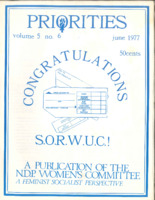 Victory for Women An Article by Cynthia Flood in Priorities Vol 5 Numer 06, June 1977. An article about bank workers rights as they received the right to unionize branch-by-branch.
 -
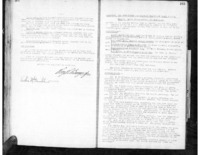 VDTLC Minutes - Research selection 1937-1941 VDTLC scanned minutes (June 1937-June 1941) various years, related to Case Study 1 research spreadsheet CVA VDTLC Minutes 1930-1948 . Issues relevant to Case Study 1 include: 1931 Feb 3, Chinese cooks support the waitress strike; 1937 May 3, Restaurant Employers and their association attempt to form parallel restaurant sector unions to undermine the HREU. 1938, Dual organizing (related to the communist contingent) begins 1938 Mar 15, A pushback against "anti-orientalism" begins from Asian HREU members and others, Like Bill Stewart. 1939 Mar 21, HREU is given jurisdiction over apartment hotels, and the Fish and Oyster Bar goes 100%union. 1940 Feb 6, Communist party expelled; Feb 20 showdown between communist leaders/dominant 1940 Oct, dual council in city with CIO established (communism) 1941 Feb 4, Report on hotel strike and settlement of the Hotel Vancouver 1941 Trouble with union houses
 -
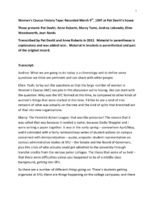 Vancouver Women's Caucus History "Because of the difficulty transcribing the tapes (bad recording equipment, several people talking at once), the tapes got put aside and were eventually misplaced. When they turned up 15 years later, Pat Davitt and Anne Roberts decided it would be a good retirement project to get the work done. They met on many Sunday mornings for nearly a year in 2013 to complete the work. After the tapes were transcribed (transcript of tape 1; transcript of tape 2), the original group (minus Andrea, who died in 2011, and Ellen, who decided she was too busy to continue working on the project) began to meet monthly in 2014 to talk about what, if anything, to do with the material. Joined by Liz Briemberg, the group decided the following priorities, depending on what energies and interest they have to follow through: The transcripts and tapes would be donated to the Women’s Caucus collection in the SFU archives; The transcripts would be circulated to other women who had been Caucus members with requests for feedback (reactions, corrections, arguments) and for additional material to fill in the gaps (in written form or in an interview format); Oral histories would be collected as much as possible from the women involved in the various workshops or subcommittees, such as the working women’s group, The Pedestal, the Indo-Chinese Women’s Conference and the education committee. (We decided that the abortion campaign was already well-documented.) To make all this material widely available to the public, a website would be created where we could also post pictures, leaflets, posters, articles, podcasts, songs and links to other historical documents, books, such as Ann Thompson’s book on the abortion battle in Canada, etc. When contacting other members, the group has been asking them to write down their own memories and analyses – when and how they got involved, what happened and why, and what they did after Women’s Caucus. The idea is to make all this material available on a website somewhat like Wikipedia in that everyone would have a chance to post what they want and no editorial board would exercise control of the content (except in the unlikely event of libel, racism, sexism, etc.) The group has been soliciting everyone to get out those old boxes stored in attics and help them obtain any leaflets, articles, posters, pictures, etc. to compile a complete record as possible. [https://www.vancouverwomenscaucus.ca/herstory/early-days/]
 -
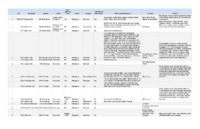 Vancouver White Help Restaurants: Newspaper ads and promotional writing (1929-1949) Survey of newspaper want ads, commercials, and promotional writing with mentions of "white help", "white help only", "white cooks". Includes union status, other descriptive language, owners names and bios. While multiple search strategies were employed on newspapers.com this does not claim to be a complete record. Some restaurants felt the promotion of their "white help only" status was a selling point for clients. 1/3 of restaurants found in this scan were HREU members.
 -
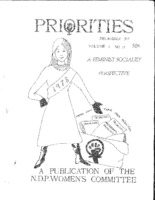 Update on the Bimini Strike An Article by Joan Woodward in Priorities Vol 5 Numer 12, December 1977. It provides more details on Bimini's strike, it explains the "fading away" operation from the employer through an interview with a waitress, Margot Holmes. The workers awere asking for benefits and a fair contract.
 -
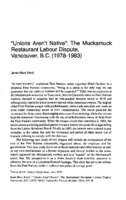 Unions Aren't Native: The Muckamuck Restaurant Labour Dispute Vancouver BC (1978-1983) Essay by Janet Mary Nicol on the Muckamuck dispute affecting First Nations restaurant workers represented by SORWUC,
 -
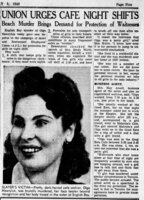 Union Urges Cafe Night Shifts A newspaper article documenting the HREU (AFL)'s call for changes to shift work in cafes and restaurants, following the murder of waitress Olga Hawryluk by a customer. She had been returning home from work at 3am. Speaking for HREU are Mrs. Emily Watts, HREU organizer, and Mrs. May Ansell [AKA Martin], HREU Business Agent.
 -
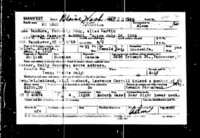 U.S., Border Crossings from Canada to U.S., 1895-1960 for Catherine McLeod This item documents the maiden and married names, and alias, Kay Martin, of a spokesperson for the White waitresses working in Chinatown, Vancouver, cafes who were forced out of their jobs by the City of Vancouver and the Vancouver Police Chief in 1937.
 -
 The Mothers' Council of Vancouver: Holding the Fort for the Unemployed, 1935-1938. An article document The Mothers' Council of Vancouver history and their work with the unemployed 1935-1938. Author Irene Howard.
 -
 Suzie Fawcett Interview [Women's Labour History Project] An interview of Suzie Fawcett conducted by Sara Diamond. Fawcett discusses the difficulty of attaining training as a working class woman; waitress work at the Hotel Vancouver; working conditions in CNR owned hotels; the HREU’s attempt to organize the hotel in 1942; subsequent radicalization of staff; the Canadian Brotherhood of Railway and Transport and General Workers organizing CNR hotels; improvement in wages; Fawcett’s opposition to political unionism; raising two children while working full-time.
 -
 SORWUC- Service, Office and Retail Workers Union Canada The Service, Office and Retail Workers Union of Canada (SORWUC) was an independent union, established in 1972 by a Founding Convention of 24 women, with the intention of representing and organizing occupations that were not included in the traditional trade unions of the time. The union developed out of the Working Women’s Association, an organization that sought to provide support to the adversities facing working women, such as obtaining equal pay, day care provision, and job security. SORWUC was an unaffiliated, feminist, member-controlled union, and their constitution stated their aims as being: to bargain collectively on behalf of members; to improve working conditions; and to help provide job security. By 1976, SORWUC had organized four day care centres, five social service units, one legal office, one student office, and a tuxedo rental store. SORWUC also began organizing bank workers in 1975 and eventually established a specific chapter for the workers in the finance industry, Local 2, United Bank Workers, and later, Local 4, Bank and Finance Workers. The union was financially supported by its members and by donations from other unions and organizations, and ran its offices on a volunteer basis. [https://guides.library.ubc.ca/labourhistoryarchives/sorwuc]
 -
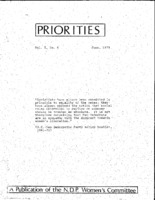 Shoppers Drug Mart/Don't Shop at Shoppers!! An article (creator withheld their name) in Priorities, Vol 1 Number 06, June 1973. It narrates the history of Shoppers strike in 1972-3.
 -
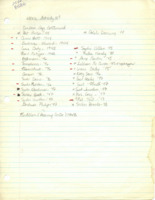 Researcher notes: Hotel and Restaurant Employees Union Local 28 activities Notes by researcher Sara Diamond from her late 1970s-early 1980s Women's Labour History Project. Diamond's notes are written in cursive and assembled in three parts. Does not always follow chronological order. 1930s-1940s
 -
 Researcher Notes on various Labour History sources. 1930s. 1940s. Sara Diamond's research notes from various sources. Good resource for communism and unions.