Case Study 1
Item set
Items
-
 Finding Aid - Sara Diamond fonds (SD) The Sara Diamond fonds spans her years in Vancouver as a member of the Revolutionary Workers League, Bread and Roses Collective, Amelia Productions, VIVO Media Arts Centre, and the Coalition for the Right To View. There are extensive materials related to Diamond’s Women’s Labour History Project, Code Zebra, curatorial projects, critical writing, educational materials, and independent video art. Diamond's fonds include photographic negatives (35mm) and prints, documents and publications (approx. 30m), audio recordings ( 200+ 1/4# and compact cassette), video recordings (500+ 3/4# Umatic, Betacam, Mini-DV), wearable art, and ephemera.
 -
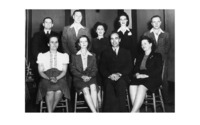 Executive of HREU Local 28 c.1947 SD_WLHP_MM3_006 Executive of H.R.E.U. Local 28 elected June 1947 [serving 1947-1948]. [Back row from left] Jimmy Lyons, Trustee; Bob Annola, Trustee; Margaret Shelton, Chairman [sic] of Education and Publicity; Gertrude Philip, Chairman of Social Committee; Roy Moore, Inspector. [Front row from left] Babella [Isabella] Beck, Recording Secretary; Emily Watts, President; Bob Williams, Vice President; May Ansell [Leniczek][Martin] , Secretary Treasurer and Business Agent.
 -
 Exclusion or Solidarity:Vancouver Workers Confront the Oriental Problem Exclusion or Solidarity:Vancouver Workers Confront the Oriental Problem by author Gillian Creese. Examing the history of labour politics in early twentieth-century British Columbia, a period marked by periods of intense anti-Asian agitation and racist legislation. "Although the la bour movement is commonly seen as an indication of developing workingclass consciousness, white workers' consciousness of a common workingclass interest in British Columbia did not extend to Asian workers."
 -
 Emily Nuttall Interview (4/5) Excerpt Emily Nuttall talks about her experience at the Milwaukee Convention in 1947 and the subsequent International takeover of the HREU Local 28 office and her explulsion from the union.
 -
Emily Nuttall Interview (3/5) Emily Nuttall discusses difficulties with organizing in restaurants (lots of turnover, its consideration as “women’s work”), changes in outlook on the profession from the Depression, her involvement with hotel organizing (particularly in the Georgia Hotel and the Belmont Hotel), and the union’s work towards shorter work weeks and the elimination of split shifts.
-
 Emily Nuttall interview Audio and transcript of Sara Diamond's interview with Emily Nutall.
 -
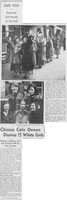 Dismissed Girls Parade To City Hall (Sep 25, 1937) Newspaper article documents the first action taken by White waitresses working in Chinatown Restaurants during a morality crackdown by the Mayor's Office and the Vancouver Police. Three Chinese-owned restaurants are threatened with having their licenses pulled if they continue to hire White waitresses. The waitresses argue that they prefer to work for Chinese restaurant owners and can't afford to lose their jobs.
 -
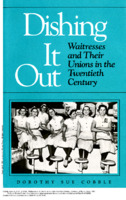 Dishing it Out: Waitresses and their Unions in the Twentieth Century Back when SOS or Adam and Eve on a raft were things to order if youwere hungry but a little short on time and money, nearly one-fourth of all waitresses belonged to unions. By the time their movement peaked in the 1940s and 1950s, the women had developed a distinctive form of working-class feminism, simultaneously pushing for equal rights and pay and affirming their need for special protections. Dorothy Sue Cobble shows how sexual and racial segregation persistedin wait work, but she rejects the idea that this was caused byemployers' actions or the exclusionary policies of male trade unionists.Dishing It Out contends that the success of waitress unionism wasdue to several factors: waitresses, for the most part, had nontraditionalfamily backgrounds, and most were primary wage-earners. Theirclose-knit occupational community and sex-separate union encouragedfemale assertiveness and a decidedly unromantic view of men andmarriage. Cobble skillfully combines oral interviews and extensivearchival records to show how waitresses adopted the basic tenets ofmale-dominated craft unions but rejected other aspects of male unionculture. The result is a book that will expand our understanding offeminism and unionism by including the gender consciousperspectives of working women. [Source: UI Press]
 -
 Denny's: the Picket Stops An article by Gillian Campbell in Priorities, Vol 1 Number 05, May 1973. Article provides updates on the case of strike action at Denny's.
 -
 CVA VDTLC Minutes 1930-1948: Researchers Notes Researcher notes taken from Vancouver District Labour Council Minutes 1930-1948.
 -
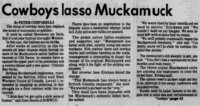 Cowboys Lasso Muckamuck (Oct 11, 1978) 4 1/2 months into the SORWUC strike at the Muckamuck restaurant, the owners open part of the premises with a cowboy theme and the new name "Chilcotin Bar Seven".
 -
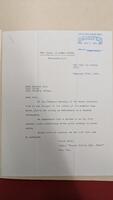 Correspondence between the League of Women Voters and the Vancouver City Clerk_17 Feb 1943 - 17 Mar 1943: White waitresses in Chinatown The League of Women Voters allege white women are working in Chinatown counter to legislation. The City Clerk replies with an interpretation of policies instituted in 1937/1938 which suggests the City may be moving away from their earlier position.
 -
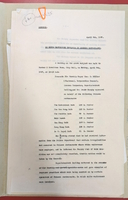 City of Vancouver Council Meeting Minutes, April 9, 1937. Vancouver City Mayor George C. Miller, Corporation Council, License Inspector, Surperintendent Darling, Mr. Denis Murphy on behalf of 7 Chinese-owned restaurants met to discuss "certain irregularities [that] have occured in Chinese restaurants where white waitresses were employed.
 -
 Chambermaids to Whistle Punks: select manuscript chapter drafts Draft chapters from Sara Diamond's unpublished book manuscript, Chambermaids to Whistle Punks
 -
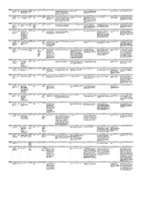 Case Study 1: Oral Histories Research document A thematic guide for the Women's Labour History Project oral histories. This work is ongoing. As of March 2024, we have drawn on oral histories from VIVO Media Arts Centre, SFU Archives, and newspaper interviews . We will soon be working on additions from other archives, like the BC Labour Heritage Centre. This multi-sheet xls spreadsheet includes (1) Object metadata for all interviews; (2) Interviewees biographical details; and (3) Research notes: select excerpts from the interview(s) and details related to our research questions (one sheet per interviewee) ID structure (1) Each interviewee is assigned a letter which is their "Subject ID" (A,B,C, etc.) (2) Each Object (research resource) is assigned an "Object ID" : a combination of the "Subject ID" and a number assigned to delineate each research resource (ie A1, A2, A3, etc). (3) Individual interviewees research sheet is identified using the individual's Subject ID followed by a colon and their surname (ie, A: Fawcett) About our Interviewee Biography sheet Drawing on publicly available resources and implementing genealogical strategies and proof standards, Knights expanded the biographies of the oral history participants. This assisted the researchers with clarifying timelines, locations, and confirming identifies. This latter step was required to ensure that we were researching the correct individual. The women regularly went by nicknames, middle names, maiden names if married, divorced surnames if single, Mrs or Miss irrespective of their actual marital status. It also gives insight into the way waitresses shifted marital status for protection, anonymity, or hirability. The biographic and demographic material also informs the interviewees own statements on why they became involved in union activity or activist movements.
 -
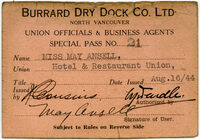 Burrard Dry Dock pass Burrard Dry Dock pass for Mary Ansell, HREU representative. Original: printed card with signature.
 -
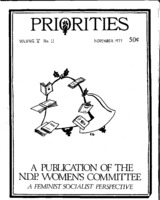 Bimini's Strike An Article by Ardith Roscoe in Priorities Vol 5 Numer 11, November 1977. In the index page, the title appears as "Bimini's Strike" but on the article page it is "Boycot Bimini's." The article presents the begining of the strike, information on strike vote, and context to the actions.
 -
 Below Stairs: The Domestic Servant "Below the Stairs: The Domestic Servant" by Marilyn J. Barber.
 -
Be Labouring Women's Imagery: The Work of the Women's Labour History Project. A Personal / Public Narrative by Sara Diamond. Presented at a Winnipeg Conference. Essay manuscript for "Be Labouring Women's Imagery: The Work of the Women's Labour History Project - A Personal / Public Narrative" by Sara Diamond.
-
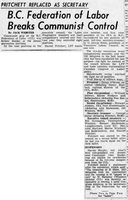 BC Federation of Labour Breaks Communist Control At the annual convention elections, 5 of 9 labor progressive members and their allies on the executive council, lost their positions and the Canadian Congress of Labour (CCL) majority.
 -
Barbara Stewart interview Audio and transcript of Sara Diamond's interview with Barbara Stewart.
-
 An unsigned copy of a collective agreement between Jericho PUB Inc. and SORWUC (1984-1985). Collective Agreement Between Jericho PUB Inc. (the Employer) and SORWUC, Local 1 (the Union). Effective: May 7, 1984 - January 31, 1985
 -
 A Preliminary Sketch of Chinese Women and Work in British Columbia 1858-1950. A Preliminary Sketch of Chinese Women and Work in British Columbia 1858-1950 by Tamara Adilman.
 -
 A Brief History of SORWUC A brief history of SORWUC, published by SORWUC.
 -
A Bibliography of Women's Trade Union History in BC 1935 - 1950 This is a bibliography of sources for research into the history of women in the B.C. trade union movement. It covers a fifteen year period: 1935-1950. These years were chosen because they represent a time of dramatic changes both in the position of women within production and of the ideology and strength of the organized labour movement in the province. The material in this bibliography is located in the Lower Mainland area. There is additional primary material in the Public Archives of British Columbia, located in Victoria. Permission is needed to use trade union archives. [From the Introduction]