Items
In item set
Anti-Asian Racism
-
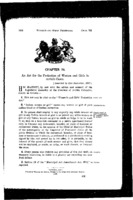 Women and Girls' Protection Act, Chapter 76 Women and Girls' Protection Act, Chapter 76, 1923
 -
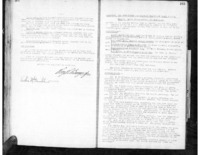 VDTLC Minutes - Research selection 1937-1941 VDTLC scanned minutes (June 1937-June 1941) various years, related to Case Study 1 research spreadsheet CVA VDTLC Minutes 1930-1948 . Issues relevant to Case Study 1 include: 1931 Feb 3, Chinese cooks support the waitress strike; 1937 May 3, Restaurant Employers and their association attempt to form parallel restaurant sector unions to undermine the HREU. 1938, Dual organizing (related to the communist contingent) begins 1938 Mar 15, A pushback against "anti-orientalism" begins from Asian HREU members and others, Like Bill Stewart. 1939 Mar 21, HREU is given jurisdiction over apartment hotels, and the Fish and Oyster Bar goes 100%union. 1940 Feb 6, Communist party expelled; Feb 20 showdown between communist leaders/dominant 1940 Oct, dual council in city with CIO established (communism) 1941 Feb 4, Report on hotel strike and settlement of the Hotel Vancouver 1941 Trouble with union houses
 -
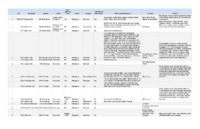 Vancouver White Help Restaurants: Newspaper ads and promotional writing (1929-1949) Survey of newspaper want ads, commercials, and promotional writing with mentions of "white help", "white help only", "white cooks". Includes union status, other descriptive language, owners names and bios. While multiple search strategies were employed on newspapers.com this does not claim to be a complete record. Some restaurants felt the promotion of their "white help only" status was a selling point for clients. 1/3 of restaurants found in this scan were HREU members.
 -
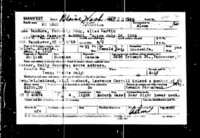 U.S., Border Crossings from Canada to U.S., 1895-1960 for Catherine McLeod This item documents the maiden and married names, and alias, Kay Martin, of a spokesperson for the White waitresses working in Chinatown, Vancouver, cafes who were forced out of their jobs by the City of Vancouver and the Vancouver Police Chief in 1937.
 -
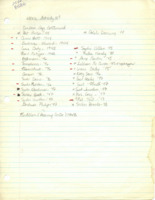 Researcher notes: Hotel and Restaurant Employees Union Local 28 activities Notes by researcher Sara Diamond from her late 1970s-early 1980s Women's Labour History Project. Diamond's notes are written in cursive and assembled in three parts. Does not always follow chronological order. 1930s-1940s
 -
 Making and defending intimate spaces: White waitresses policed in Vancouver's Chinatown cafes. Sia's thesis looks at the campaign by the Mayor and VPD against white waitresses working at Chinese-owned cafes in Chinatown that eventually led to protests by the waitresses, claims of immorality, cancelled business and an eventual settlement that saw the women fired from their jobs during the depression. licences MA Thesis, UBC 2010 fall. Rosanne Sia.
 -
 Historical discrimination against Chinese people in Vancouver A report presented to Vancouver City Council by the General Manager of Community Services on Oct 20, 2017. The report outlines the evidence of historical discrimination against Chinese people in Vancouver.
 -
 Exclusion or Solidarity:Vancouver Workers Confront the Oriental Problem Exclusion or Solidarity:Vancouver Workers Confront the Oriental Problem by author Gillian Creese. Examing the history of labour politics in early twentieth-century British Columbia, a period marked by periods of intense anti-Asian agitation and racist legislation. "Although the la bour movement is commonly seen as an indication of developing workingclass consciousness, white workers' consciousness of a common workingclass interest in British Columbia did not extend to Asian workers."
 -
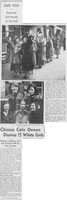 Dismissed Girls Parade To City Hall (Sep 25, 1937) Newspaper article documents the first action taken by White waitresses working in Chinatown Restaurants during a morality crackdown by the Mayor's Office and the Vancouver Police. Three Chinese-owned restaurants are threatened with having their licenses pulled if they continue to hire White waitresses. The waitresses argue that they prefer to work for Chinese restaurant owners and can't afford to lose their jobs.
 -
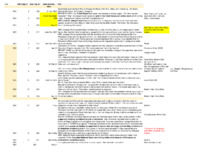 CVA VDTLC Minutes 1930-1948: Researchers Notes Researcher notes taken from Vancouver District Labour Council Minutes 1930-1948.
 -
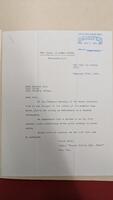 Correspondence between the League of Women Voters and the Vancouver City Clerk_17 Feb 1943 - 17 Mar 1943: White waitresses in Chinatown The League of Women Voters allege white women are working in Chinatown counter to legislation. The City Clerk replies with an interpretation of policies instituted in 1937/1938 which suggests the City may be moving away from their earlier position.
 -
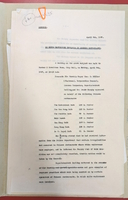 City of Vancouver Council Meeting Minutes, April 9, 1937. Vancouver City Mayor George C. Miller, Corporation Council, License Inspector, Surperintendent Darling, Mr. Denis Murphy on behalf of 7 Chinese-owned restaurants met to discuss "certain irregularities [that] have occured in Chinese restaurants where white waitresses were employed.
 -
 Case Study 1: Oral Histories Research document A thematic guide for the Women's Labour History Project oral histories. This work is ongoing. As of March 2024, we have drawn on oral histories from VIVO Media Arts Centre, SFU Archives, and newspaper interviews . We will soon be working on additions from other archives, like the BC Labour Heritage Centre. This multi-sheet xls spreadsheet includes (1) Object metadata for all interviews; (2) Interviewees biographical details; and (3) Research notes: select excerpts from the interview(s) and details related to our research questions (one sheet per interviewee) ID structure (1) Each interviewee is assigned a letter which is their "Subject ID" (A,B,C, etc.) (2) Each Object (research resource) is assigned an "Object ID" : a combination of the "Subject ID" and a number assigned to delineate each research resource (ie A1, A2, A3, etc). (3) Individual interviewees research sheet is identified using the individual's Subject ID followed by a colon and their surname (ie, A: Fawcett) About our Interviewee Biography sheet Drawing on publicly available resources and implementing genealogical strategies and proof standards, Knights expanded the biographies of the oral history participants. This assisted the researchers with clarifying timelines, locations, and confirming identifies. This latter step was required to ensure that we were researching the correct individual. The women regularly went by nicknames, middle names, maiden names if married, divorced surnames if single, Mrs or Miss irrespective of their actual marital status. It also gives insight into the way waitresses shifted marital status for protection, anonymity, or hirability. The biographic and demographic material also informs the interviewees own statements on why they became involved in union activity or activist movements.
 -
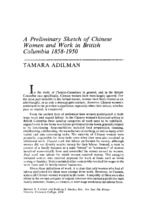 A Preliminary Sketch of Chinese Women and Work in British Columbia 1858-1950. A Preliminary Sketch of Chinese Women and Work in British Columbia 1858-1950 by Tamara Adilman.